AI Readiness Checker: Is Your Website Ready for AI Search? (2026)

Last quarter I audited a client site that ranked beautifully on Google and got zero citations from ChatGPT. The content was strong. The problem was invisible: their robots.txt quietly blocked GPTBot, and their pages rendered almost entirely through client-side JavaScript. To an AI crawler, the site looked empty. They were ready for 2015 search and locked out of 2026 search.
That gap is what an AI readiness check measures. Before you worry about whether AI engines recommend you, you need to know whether they can even read you.
This guide explains what AI readiness means, the exact signals that decide it, and how to run a free, no-signup check on any URL in about ten seconds.
What AI Readiness Means (and Why It Differs From SEO)
AI readiness is a measure of whether AI search engines can crawl your pages, extract your content, and quote it in an answer. It is a technical and structural property of your site, not a ranking. Think of it as the entry ticket to AI search: if you fail it, nothing else you do matters.
Traditional SEO asks “can Google rank this page?” AI readiness asks a different question: “when someone asks ChatGPT or Perplexity about this topic, can the engine pull a clean, quotable answer from your page?” Those are related but not the same. A page can rank on page one and still be unusable to an AI engine.
Here is why this matters right now. Over 800 million people use ChatGPT weekly, and Google AI Overviews now appear in more than 50% of searches. AI search stopped being a side channel. For many topics, the AI answer is the first thing your audience sees, and often the only thing.
The shift from ranking to citation changes what you optimize:
| Dimension | Traditional SEO | AI Readiness |
|---|---|---|
| Goal | Rank a page in results | Get content quoted in an answer |
| Crawler | Googlebot, Bingbot | GPTBot, ClaudeBot, PerplexityBot |
| Unit of value | The clicked page | The extracted sentence or table |
| Key blocker | Thin content, weak links | Blocked bots, unreadable HTML |
| Winner | Highest relevance signal | Clearest, most quotable source |
The good news: most readiness problems are fixable in an afternoon. They are configuration issues, not content rewrites. You just have to find them first.
AI Crawler Access: The robots.txt Problem
AI crawler access is whether the specific bots that power AI engines are allowed to fetch your pages. This is controlled by your robots.txt file, and it is the single most common reason a site is invisible to AI search. If you block the bot, your content cannot be cited. Full stop.
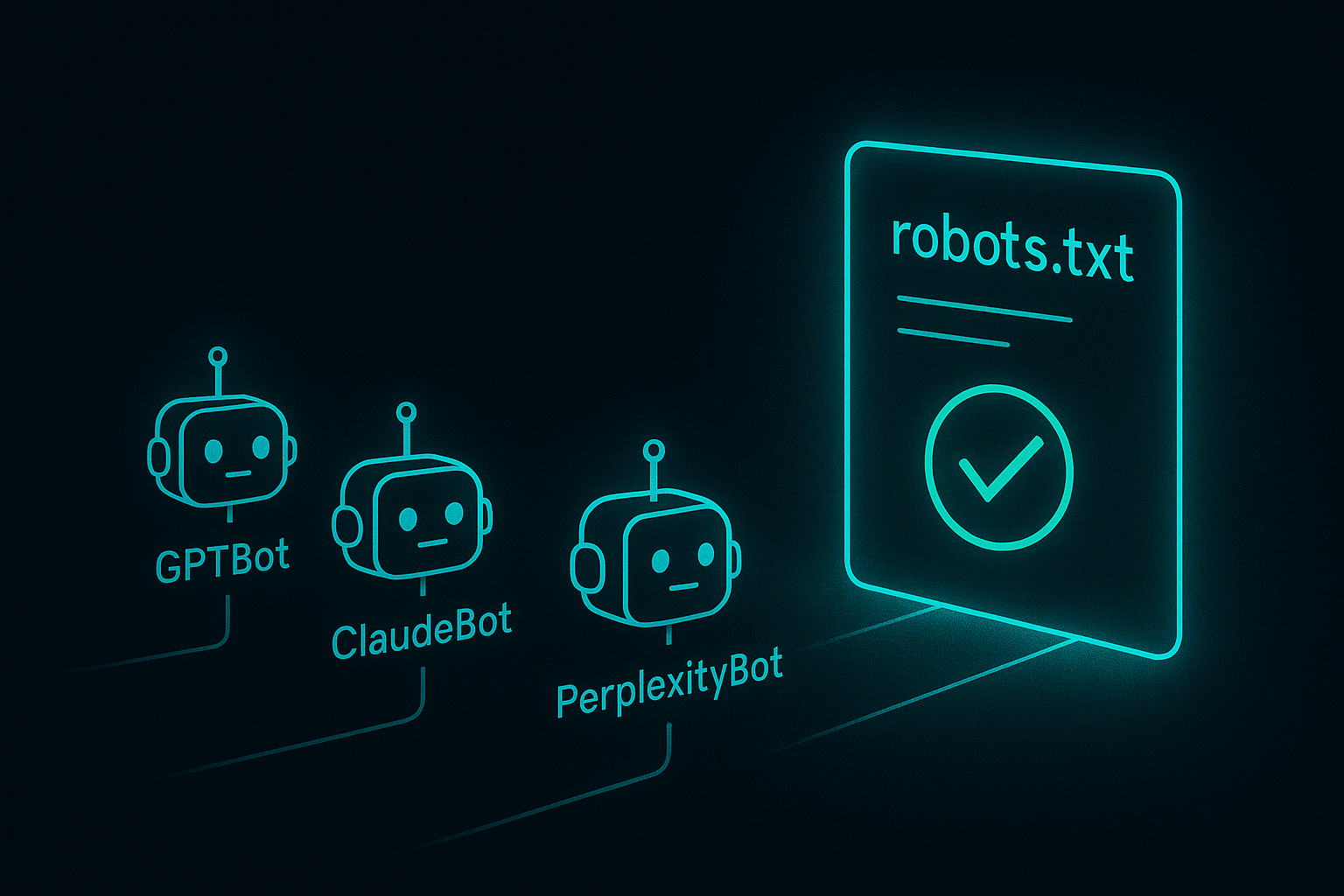
Each major AI platform runs its own user-agent. Blocking any of these removes you from that platform’s answers.
| User-agent | Operator | What it feeds |
|---|---|---|
| GPTBot | OpenAI | ChatGPT training and browsing |
| OAI-SearchBot | OpenAI | ChatGPT search results |
| ClaudeBot | Anthropic | Claude training and answers |
| PerplexityBot | Perplexity | Perplexity real-time answers |
| Google-Extended | Gemini and AI Overviews training | |
| CCBot | Common Crawl | Open dataset many models train on |
| Bingbot | Microsoft | Copilot and Bing generative answers |
Many sites block these bots without realizing it. Sometimes a security plugin adds the rules. Sometimes a developer copies a “block AI scrapers” snippet from a forum. Sometimes a CDN like Cloudflare enables bot-blocking by default. The result is the same: your best content becomes uncitable.
Here is a robots.txt that explicitly welcomes the major AI crawlers while keeping your admin paths private:
# Allow AI crawlers to read and cite your content
User-agent: GPTBot
Allow: /

User-agent: OAI-SearchBot
Allow: /

User-agent: ClaudeBot
Allow: /

User-agent: PerplexityBot
Allow: /

User-agent: Google-Extended
Allow: /

User-agent: CCBot
Allow: /

# Everyone else: standard rules
User-agent: *
Allow: /
Disallow: /admin/
Disallow: /cart/

Sitemap: https://yourwebsite.com/sitemap.xml
One nuance worth knowing. Blocking GPTBot stops OpenAI from training on your content, but it can also stop ChatGPT from citing you in live answers. If you want the visibility, you have to let the bots in. That is a business decision, but most sites that want AI traffic should allow them.
llms.txt: The Signpost for AI Engines
llms.txt is a plain-text Markdown file you place at the root of your domain that tells AI engines what your site is about and points them to your most important pages. Think of it as a curated map built for machines, the same way a sitemap serves search crawlers. It lives at https://yourwebsite.com/llms.txt.
The file gives an AI a fast, clean summary instead of forcing it to infer your structure from navigation and internal links. A basic version looks like this:
# Your Company

> One-sentence description of what you do and who you help.

## Core Pages
- [Product overview](https://yourwebsite.com/product): What we build
- [Pricing](https://yourwebsite.com/pricing): Plans and costs
- [Docs](https://yourwebsite.com/docs): Setup and API guides

## Guides
- [Getting started](https://yourwebsite.com/start): Step-by-step onboarding
The standard is still young, and not every engine consumes it yet. I treat it as low-cost insurance. It takes fifteen minutes to write, it cannot hurt you, and adoption is climbing. If you publish reference content, docs, or guides, it is worth having. You can read the llms.txt proposal for the full spec.
Machine Readability: Schema, Meta, and Rendering
Machine readability is how easily a bot can parse the actual meaning of your page without guessing. It rests on three things: structured data, clean meta tags, and content that exists in the raw HTML rather than being painted on later by JavaScript. AI engines extract from what they can parse, so readability is a direct input to citation.
Structured data is the biggest lever. Schema.org markup in JSON-LD labels your content so a machine knows a price is a price, a step is a step, and an author is an author. Pages with the right schema get cited at higher rates because the engine trusts the extraction. Prioritize these types:
- Article for blog posts and guides
- FAQPage for question-and-answer blocks
- HowTo for step-by-step instructions
- Organization and Person for entity and author identity
- Product for anything you sell
Meta tags still matter, but for a machine audience. A clear title tag, a real meta description, and canonical tags help an AI understand the page’s purpose and avoid duplicate confusion. Open Graph tags help too, since some engines use them for summaries.
The quiet killer is rendering. If your content only appears after JavaScript runs in a browser, many AI crawlers never see it. Googlebot renders JavaScript reasonably well, but most AI bots do a lighter fetch and read the raw HTML. Server-side rendering or static generation puts your words where the bot can find them. When in doubt, view the page source and confirm your main content is actually in there.
Answerability: The Content Shapes AI Quotes
Answerability is whether your content is structured so an AI can lift a clean, self-contained answer straight from the page. Even a perfectly crawlable page fails here if the useful information is buried in a wandering ten-sentence paragraph. AI engines quote units, not vibes. They want a definition, a step, a stat, or a row.
The formats that get quoted share a pattern: they answer one question in one place, plainly. These are the highest-value structures:
- Definitions up front. Open a section by defining the term in one sentence, the way this section starts.
- Question-style headings. An H2 or H3 phrased as a real question (“What is llms.txt?”) matches how people prompt AI.
- Direct answers under headings. Put a 40-to-60-word answer immediately below the heading, before you elaborate.
- Tables and lists. Comparison tables and numbered steps are the most extractable formats on the web.
- Stats with sources. A specific number with a named citation reads as trustworthy, so engines quote it.
FAQ blocks deserve special mention. A page with genuine questions and tight answers, backed by FAQPage schema, is close to ideal AI food. According to research summarized by Backlinko on how AI search works, clarity and structure are what push a source into the answer, not keyword density. Write for the person, then format for the machine.
How to Run the Check and Read Your Grade
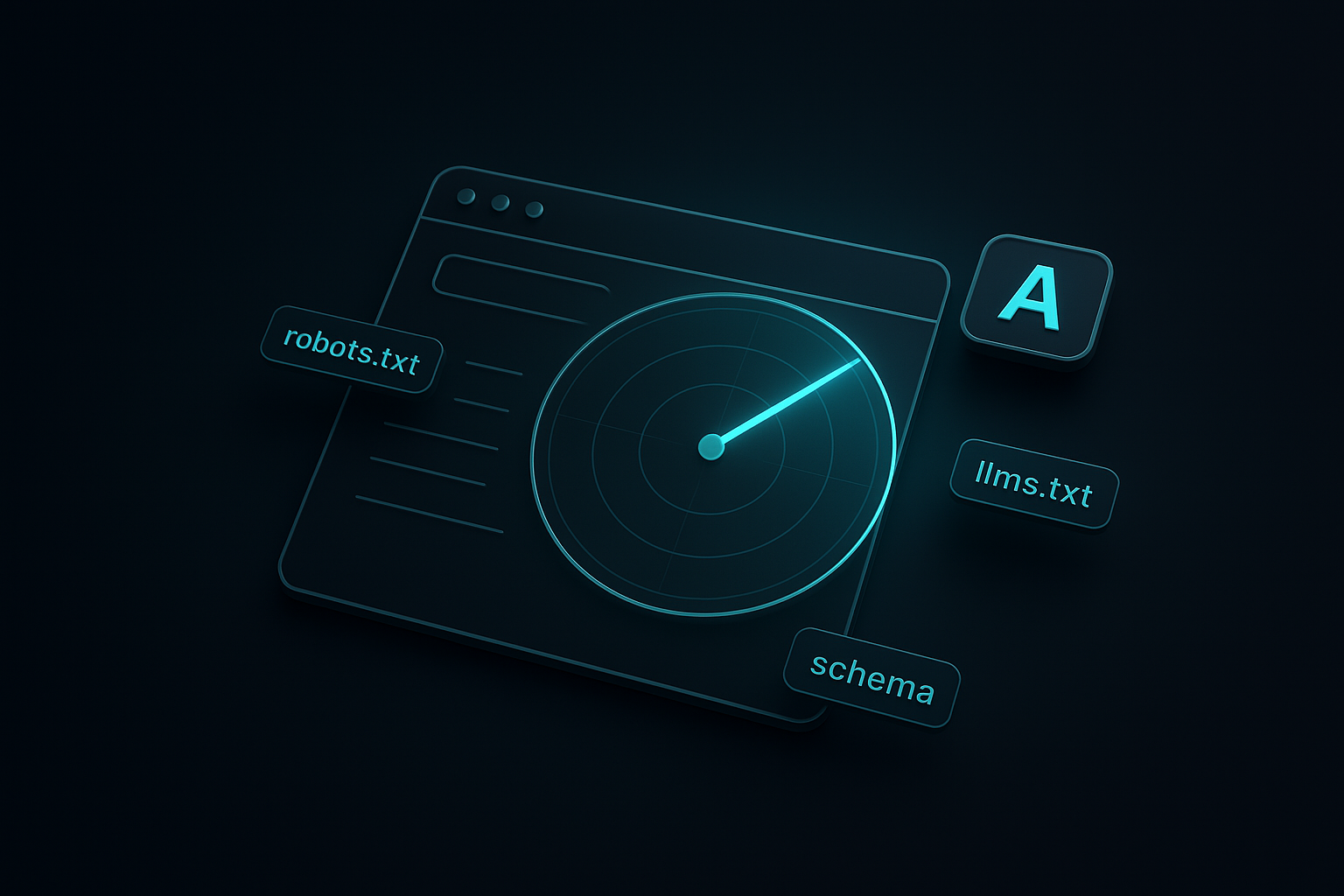
The AI Readiness Checker scans any URL and returns a letter grade with four category scores plus a prioritized fix list. It runs in seconds, needs no signup, and works on any public site, including your competitors’. Just click the Check My Site button at the top of this page and paste your URL.
Here is how to use it, step by step:
- Enter your homepage URL in the tool at the top of this page and click Check My Site.
- Read your overall grade. The A-to-F score is your at-a-glance verdict on AI readiness.
- Scan the four category scores to see where the damage is. Each maps to a section above.
- Open the prioritized fix list. It ranks issues by impact, so you fix the citation-blockers first.
- Apply the top fixes, then re-run the check to confirm your grade moved.
- Run it on two competitors to see whether readiness is your edge or your gap.
The four categories map directly to what AI engines evaluate:
| Category | What it measures | Common failure |
|---|---|---|
| AI Crawler Access | Are GPTBot, ClaudeBot, PerplexityBot allowed? | robots.txt blocks bots |
| Content Structure | Headings, lists, tables, answerable format | Wall-of-text pages |
| Machine Readability | Schema, meta tags, server-rendered HTML | Missing JSON-LD, JS-only content |
| Answerability | Definitions, Q&A, quotable units | No direct answers to extract |
A quick way to read the grade. An A or B means the technical door is open and AI engines can work with your content. A C means fixable friction, usually thin schema or weak structure. A D or F almost always means a hard blocker: bots are banned or the content is invisible in raw HTML. Blockers first, polish second.
One honest caveat. A great readiness grade means AI can cite you. It does not guarantee AI will cite you. Readiness is necessary but not sufficient. Once you pass the readiness check, the next question is whether you actually show up in answers, and that is a different measurement.
From Readiness to Visibility: The Next Step
Readiness and visibility are two halves of AI search. Readiness asks whether AI can read you. Visibility asks whether AI actually recommends you when someone asks about your space. You have to win the first before the second is even possible.
Once your readiness grade is solid, run the AI Visibility Checker to see whether you show up in real AI answers for your topics, and which competitors get named instead of you. That is the natural next move: fix the plumbing here, then measure the payoff there.
It also helps to feed the machine the right topics. Pair your readiness work with a smart keyword research guide so the questions you answer match how people actually prompt AI. Structure follows strategy. Know the questions first, then format your pages to answer them cleanly.
If you want the short version of the workflow: audit readiness on your top ten pages, clear any crawler blocks, add schema to your best content, then track visibility monthly. Repeat quarterly. The AI answer landscape shifts fast, and the sites that check regularly are the ones that hold their ground.
Frequently Asked Questions
Can I check if ChatGPT can read my site?
Yes. Paste your URL into the AI Readiness Checker at the top of this page and it will test whether OpenAI’s crawlers (GPTBot and OAI-SearchBot) are allowed and whether your content is readable in raw HTML. If either fails, ChatGPT cannot reliably cite you. The check takes about ten seconds and needs no signup.
Does blocking GPTBot hurt my SEO?
Blocking GPTBot does not affect your Google rankings, because Googlebot is a separate crawler. What it hurts is your AI visibility. When you block GPTBot, you remove your content from ChatGPT’s ability to cite you in answers. If you want traffic and mentions from AI search, you should allow the AI crawlers, not block them.
What is llms.txt?
llms.txt is a plain-text Markdown file placed at your domain root that tells AI engines what your site is about and links to your most important pages. It works like a sitemap built for language models, giving them a clean summary instead of forcing them to infer your structure. Adoption is still early, but it takes minutes to add and cannot hurt.
Why does my site get Google traffic but no AI citations?
Usually one of three things. Your robots.txt blocks AI crawlers even though it allows Googlebot. Your content renders through JavaScript that AI bots do not execute. Or your pages lack the structure and schema that make content extractable. Google is more forgiving on all three, so a site can rank well and still be invisible to AI. The readiness check pinpoints which issue is yours.
How is AI readiness different from AI visibility?
Readiness measures whether AI engines can crawl, read, and cite your site. Visibility measures whether they actually do recommend you in answers. Readiness is a technical prerequisite you control directly. Visibility is the outcome, and it depends on readiness plus authority and content quality. Fix readiness first with this tool, then measure visibility with the AI Visibility Checker.
Do I need schema markup for AI search?
You do not strictly need it, but it helps a lot. Schema.org markup in JSON-LD labels your content so machines parse it with confidence, and pages with the right schema get cited at higher rates. Start with Article, FAQPage, and HowTo on your most important pages. It is one of the highest-return fixes on the readiness checklist.
Want AI search strategies in your inbox? Subscribe to my newsletter for practical tips on getting your site read, cited, and recommended by AI engines, sent every week.