AI Visibility Checker: Does ChatGPT Recommend Your Business? (2026)

Last week a client asked me a question I could not answer from a rankings dashboard: “When someone asks ChatGPT for the best company in our category, do they say us?” We checked. ChatGPT named two competitors and never mentioned my client once. That client ranks on page one of Google for the same query.
AI visibility is whether AI assistants name and cite your brand when buyers ask category questions. It is the new rank tracking. With ChatGPT reaching roughly 800 million weekly users and Perplexity handling hundreds of millions of queries a month, a growing share of your buyers now ask an AI instead of scrolling a results page.
This guide explains what AI visibility is, how mentions and citations differ, and why the prompts you test must be backed by real search demand. Then I will walk you through running a free check on your own brand.
What AI Visibility Is and Why It Replaces Rank Tracking
AI visibility measures how often AI assistants like ChatGPT and Perplexity mention or cite your brand when users ask questions in your category. Traditional rank tracking asks “where does my page sit in a list of blue links.” AI visibility asks a different question: “when the AI writes the answer, does my brand appear in it at all.”
The shift matters because AI answers are winner-take-few. A results page shows ten links, so ranking fifth still earns clicks. An AI answer often names two or three brands and stops. If you are not one of them, you are invisible, not fourth.
Here is the uncomfortable part. A brand can be completely invisible on ChatGPT while a competitor gets named every single time. Rankings do not guarantee AI mentions. The AI synthesizes from sources it trusts, and that logic is not your Google position.
Adoption is why this is urgent, not theoretical:
- ~800 million people use ChatGPT every week (Semrush)
- AI-driven referral traffic to websites is growing more than 10x year over year
- Perplexity answers hundreds of millions of queries monthly, most of them question-shaped
If your buyers are asking AI which company to hire or which product to buy, your visibility in those answers is a revenue channel. Most businesses have never measured it.
Why You Cannot Eyeball This
I used to spot-check by typing one question into ChatGPT and reading the answer. That is worse than useless. AI answers vary by phrasing, by session, and by engine. One lucky prompt where you get named tells you nothing about the ten prompts where you do not. You need a structured set of buyer questions, run across multiple engines, scored consistently. That is the difference between a hunch and a scorecard you can send to your boss.
Mentions vs Citations vs Share of Voice
These three terms get used interchangeably, and that causes bad decisions. Let me define each one plainly, because they measure different things.
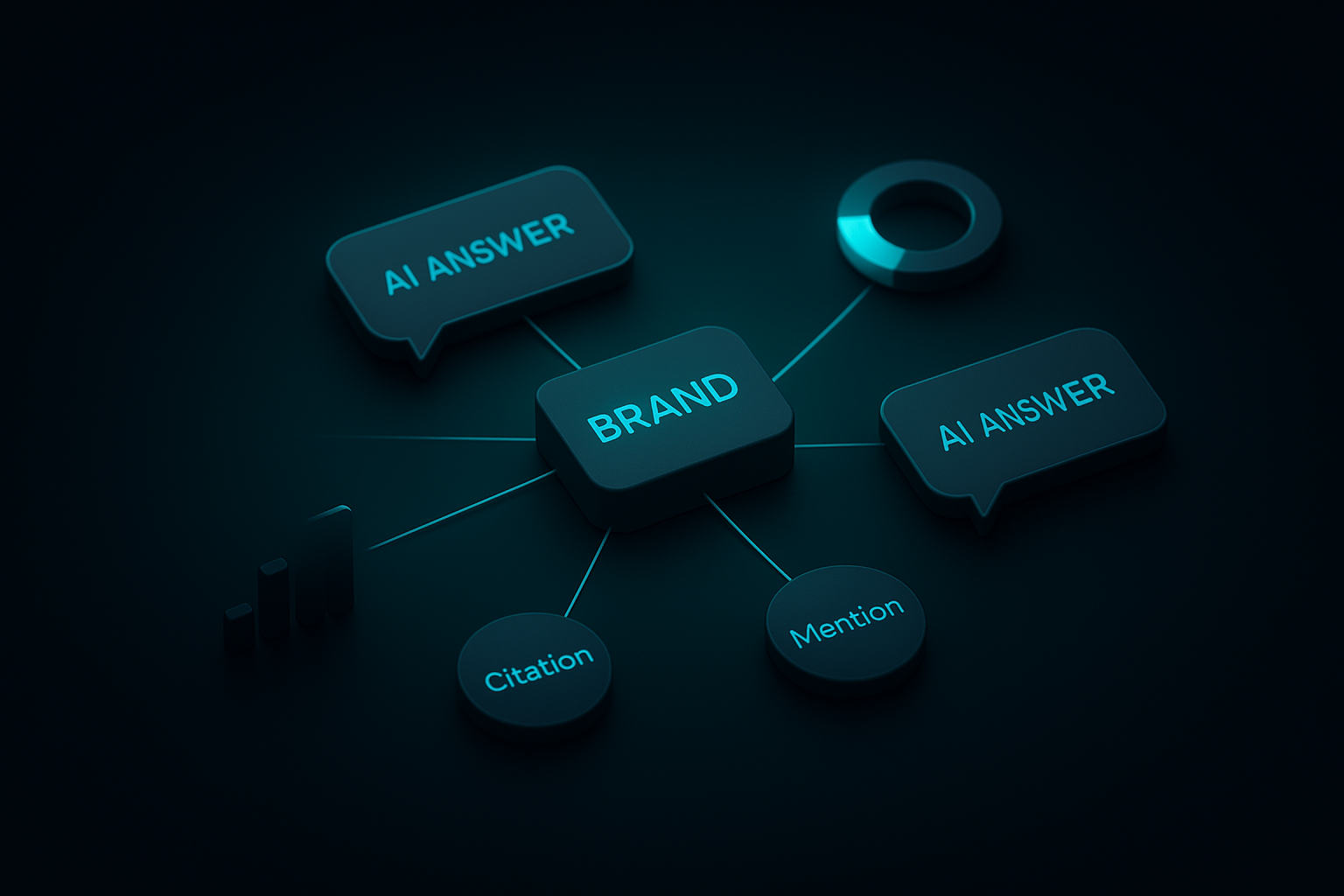
A mention is when the AI names your brand in its answer text. A citation is when the AI links to your website as a source for the answer. Share of voice is your slice of all brand mentions in a given answer set compared to competitors.
| Metric | What It Measures | Example | Why It Matters |
|---|---|---|---|
| Mention | Your brand named in the answer text | ”Popular options include Acme and Bolt.” | Awareness. Buyers see your name in the recommendation. |
| Citation | Your site linked as a source | Answer links to acme.com/pricing | Authority and referral traffic. The AI trusts your page. |
| Share of Voice | Your mentions vs all competitor mentions | You get 2 of 10 total mentions = 20% SoV | Competitive position across the whole category. |
You can be mentioned without being cited, and cited without being mentioned. ChatGPT might recommend your brand by name but link to a review site instead of your domain. Perplexity might cite your blog post as a source without naming your company in the summary.
I track all three because they trigger different fixes. Low mentions means the AI does not know you belong in the category. Low citations means your pages are not structured to be quoted. Low share of voice means competitors are louder in the sources AI reads.
Why Prompt Selection Must Be Demand-Backed
Here is the mistake almost every AI visibility tool makes: it invents the prompts. Someone guesses at questions buyers “probably” ask, tests those, and hands you a score. If the questions are wrong, the score is fiction.
A visibility check is only as good as the prompts it runs. If you test questions nobody actually searches, a perfect score means nothing and a bad score means nothing. You measured demand that does not exist.
This is the core of how my tool works differently. It does not guess. It pulls real DataForSEO keyword and question demand for your category plus your city, ranks those seeds by actual Google search volume, and converts the top ones into conversational buyer prompts. Every prompt is shown with its backing Google volume and an estimated AI-search volume, so you see the demand behind each question before you run it.
Grounding prompts in real search data is the differentiator. You are not testing questions I imagined. You are testing questions your market is measurably asking, phrased the way people talk to an AI.
The Four Prompt Types That Matter
Not all buyer questions look the same. The tool builds a mix across the formats that actually drive AI recommendations:
- Best-X prompts: “What is the best [category] in [city]?” These are pure recommendation queries where the AI hands out names.
- X-vs-Y prompts: “Is [Brand A] or [Brand B] better for [use case]?” Comparison queries reveal whether you show up next to named rivals.
- Recommendation prompts: “Who should I hire for [service]?” Open-ended asks where the AI decides which brands to surface.
- Local near-me and city prompts: “[Service] near me” and “[service] in [city].” Location-grounded queries where a strong local business can win even against bigger national names.
Each type stresses your visibility differently. Best-X and recommendation prompts test whether you are top of mind. Comparison prompts test whether you survive a head-to-head. Local prompts test whether geography works in your favor. For the deeper mechanics of turning demand into buyer language, my keyword research guide covers how conversational queries differ from typed search.
Engine-Level Differences: Check Both
The single most important thing I have learned running these checks: the same query can name your brand on Perplexity and omit it entirely on ChatGPT. These engines build answers from different source pools, so their brand selection diverges hard.
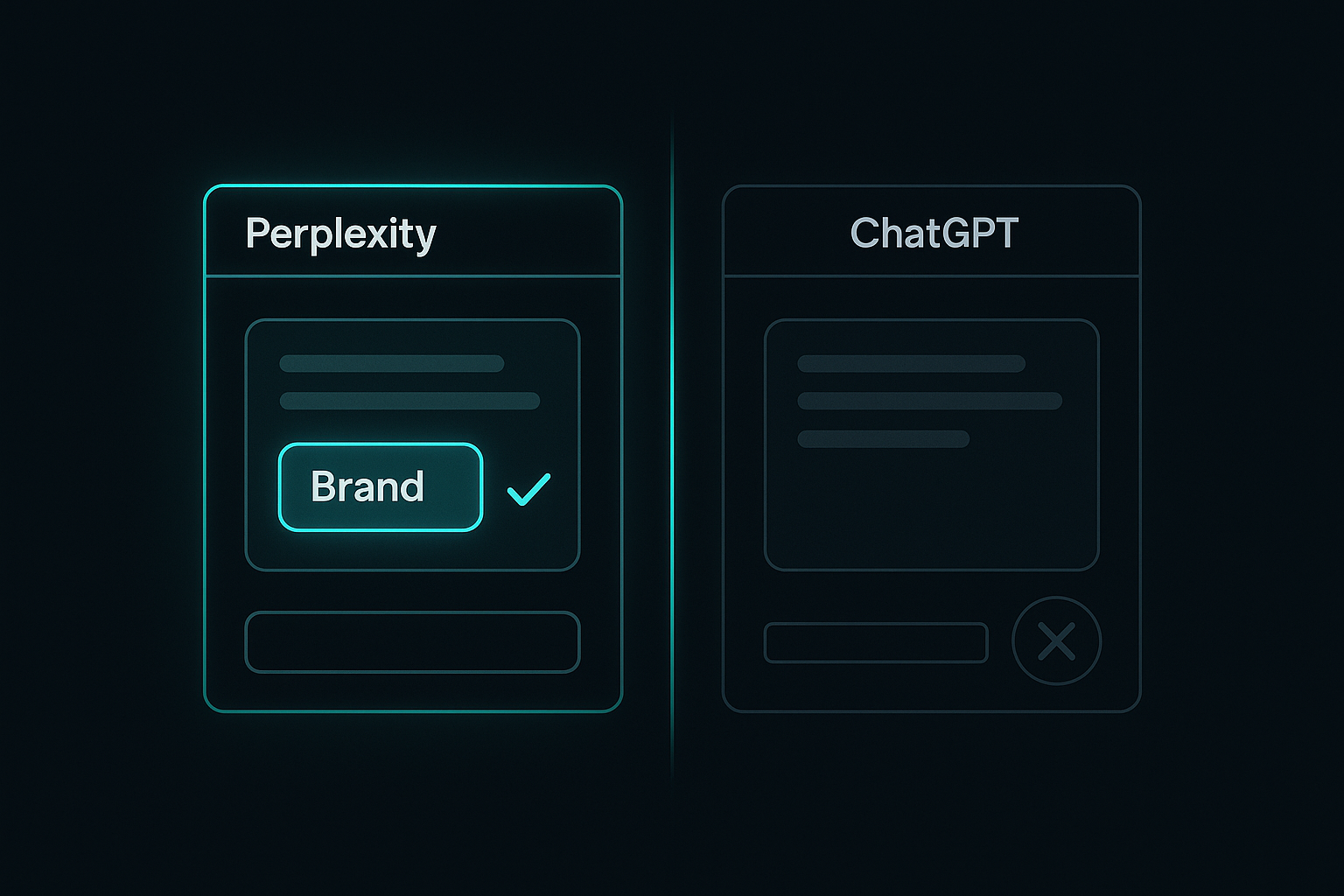
I checked a local service business recently. On Perplexity, its site was cited on four of ten prompts because Perplexity leans on fresh web results and local pages. On ChatGPT, the same business appeared zero times, because ChatGPT drew on older training data and national directory sites. Same company, same questions, opposite verdict.
| Behavior | ChatGPT | Perplexity |
|---|---|---|
| Primary source style | Training data plus web search | Real-time web synthesis |
| Tends to favor | Established, encyclopedic and directory sources | Fresh pages, forums, local results |
| Citation visibility | Often names brands without linking | Cites sources inline, link-heavy |
| Best for revealing | Whether you are “known” in the category | Whether your current pages are being read |
If you only check one engine, you get half the picture and possibly the wrong half. A business strong on Perplexity might feel confident while being invisible to the 800 million people on ChatGPT. That is why the check fans every prompt out to both engines and scores them separately.
Fixes differ by engine too. Winning ChatGPT usually means becoming a recognized entity across authoritative sources over time. Winning Perplexity often means publishing fresh, well-structured pages that get read this week.
Competitor Gap Analysis: The Send-to-Boss Insight
Competitor gap analysis in AI search means seeing exactly which competitors the AI names when you are absent, then turning that list into action. This is the part clients screenshot and forward to their boss, because it is impossible to argue with.
When your brand does not appear, the AI still answers. It names someone, and the gap list shows you who. Suddenly the conversation is not “we should think about AI” but “ChatGPT recommends these three competitors by name for our top buyer question, and we are not one of them.”
Here is how I turn a gap list into a plan:
- Identify the repeat winners. Competitors that show up across multiple prompts are the brands the AI treats as category defaults.
- Find your near-misses. Prompts where a competitor barely edges you out are the fastest wins.
- Study what the AI cites for them. Structure, freshness, and clear answers usually explain the gap.
- Prioritize by demand. Fix the prompts with the highest backing search volume first, because those represent the most real buyers.
This gap view is where AI visibility stops being abstract. You are not chasing a vague score. You are closing named, ranked gaps against named competitors on questions with real demand.
How the Check Works and How to Read Your Scorecard
The check is designed to take about sixty seconds, run two free times a day, and require no signup. Here is the full flow from brand name to scorecard.
Running Your Check Step by Step
- Enter your brand and website. Type your brand name and domain so the tool can look for both name mentions and site citations.
- Add your category and location. Give your category (what you sell) and country, plus an optional city for local businesses. This is what grounds the demand pull.
- Review the ten demand-backed prompts. The tool pulls real DataForSEO demand, ranks by Google volume, and generates ten conversational buyer prompts. Each shows its backing Google volume and estimated AI-search volume.
- Edit the prompts if you want. Swap or reword any prompt. You know your buyers, so tune the set before running.
- Run the check. The tool fans all ten prompts out to ChatGPT and Perplexity and records every answer.
- Read your scorecard. Review your visibility score, mention and citation counts per engine, the competitor leaderboard, and the list of prompts where you are invisible.
That last step is where the value lives, so let me break down what each number means.
Reading the Scorecard
Your visibility score is a single number summarizing how often you appeared across all prompts and engines. It is your headline metric for tracking movement over time.
Mention and citation counts per engine split your performance by ChatGPT and Perplexity so you see where you are strong and where you are absent. These can diverge sharply, which is the point of checking both.
The competitor leaderboard ranks the brands the AI named most across your prompt set. This is your share-of-voice view and your gap list in one place.
The prompts where you are invisible list is your to-do list. These are demand-backed questions where the AI answered without you, and each one is a specific, fixable opportunity tied to real search volume.
Before you run a visibility check, confirm AI can even read your site. My AI Readiness Checker tests whether AI crawlers can access and parse your pages at all. First make sure AI can READ your site, then check whether it RECOMMENDS you.
Ready to see where you stand? Click the Build My Check button at the top of this page. Two free checks a day, about sixty seconds each, no signup. You will know within a minute whether ChatGPT and Perplexity name your business or your competitors.
Turning Your Scorecard Into a GEO Plan
Generative Engine Optimization (GEO) is the practice of getting your content mentioned and cited by AI systems. A visibility check tells you where you stand. GEO is what you do about it, and the prompts where you are invisible map directly to content work.
If you are absent on best-X queries, you need authoritative category pages that clearly state what you do and for whom. If you lose comparison prompts, you need pages that stack you against named alternatives. If local prompts miss you, you need location and service pages AI can read and trust.
I recommend rechecking monthly. AI answers shift faster than Google rankings, especially on Perplexity, which favors fresh content. A competitor who publishes a strong page can take your spot in an answer within weeks. Watching your scorecard move is how you know your GEO work is landing, and pairing it with the AI Readiness Checker keeps your pages readable while you climb.
Frequently Asked Questions
Does ChatGPT recommend my business?
Maybe, maybe not, and you cannot know without checking. ChatGPT builds answers from training data plus web results, and its brand selection does not track your Google rankings. Run a visibility check across demand-backed buyer prompts to see whether ChatGPT names you or a competitor. In my experience, plenty of businesses that rank well on Google get zero ChatGPT mentions.
How is AI visibility different from SEO rankings?
SEO rankings measure where your page sits in a list of links you must click to visit. AI visibility measures whether the AI names or cites your brand directly inside its written answer. You can rank number one and still be invisible in AI answers, and you can be cited by AI without ranking on page one. They are related but separate, and in 2026 both matter.
What is share of voice in AI search?
Share of voice is your slice of all brand mentions in an answer set compared to your competitors. If a set of prompts produces ten total brand mentions and two of them are yours, your share of voice is twenty percent. It is the cleanest way to measure your competitive position across a whole category rather than a single query. The competitor leaderboard in your scorecard is your share-of-voice view.
Which engines do you check?
The tool checks both ChatGPT and Perplexity and scores them separately. This matters because the same query can name your brand on one engine and omit it on the other, since they pull from different source pools. ChatGPT reveals whether you are a known entity in your category, while Perplexity reveals whether your current pages are being read and cited.
Why do the prompts have to be based on real search data?
Because a visibility score is only meaningful if it measures questions buyers actually ask. Guessed prompts produce a fiction. The tool pulls real DataForSEO demand for your category and city, ranks by actual Google search volume, and converts the top seeds into conversational prompts, each shown with its backing volume. That grounding separates a real measurement from a guess.
Is the AI visibility checker really free?
Yes. You get two free checks per day with no signup required, and each check takes about sixty seconds. Enter your brand, website, category, and location, review the ten demand-backed prompts, and run the check. For ongoing AI search and SEO strategy, subscribe to my newsletter for weekly tips on getting your brand mentioned and cited by AI.